By Jai Krishan·Talk & Text Hub
Last updated October 12, 2026
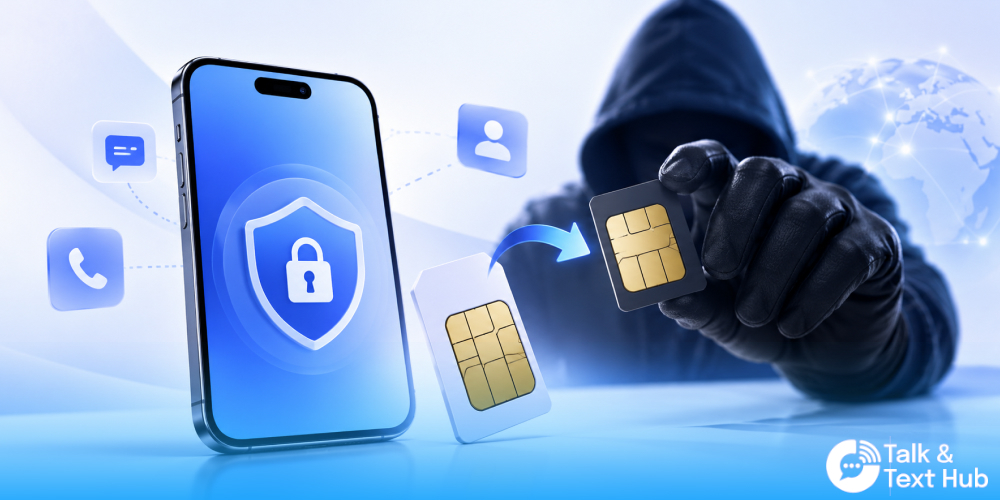
SIM Swap Scams: What They Are and How to Protect Your Number
Imagine waking up to find your phone has no signal, your bank app is locked out, and someone else is quietly resetting your passwords using texts sent to a number that's no longer yours. This isn't a hypothetical horror story; instead, it's the exact playbook behind SIM swap scams, one of the fastest-growing forms of identity fraud today. Attackers don't need to steal your physical phone; they simply convince your carrier to hand your number over to a SIM card they control.
If that sounds alarming, it should, but it's also entirely preventable once you understand how the attack works. Keep reading, because by the end of this, you'll know exactly how to recognise the warning signs and lock down your number before anyone else gets the chance to.
Anatomy of an Attack: How SIM Swap Fraud Actually Works
At its core, SIM swap fraud exploits a simple weakness: your phone number is tied to a physical SIM card, and carriers can reassign that number to a new SIM upon request. Attackers weaponise this process through a sequence that typically looks like this:
Information Gathering – Scammers collect your personal details through phishing emails, data breaches, or social media oversharing.
Carrier impersonation – Armed with enough personal data, they contact your mobile provider pretending to be you.
Social engineering the support desk – They convince a customer service representative to activate your number on a SIM card they control.
Silent takeover – Your phone loses signal entirely, while the attacker's device now receives your calls and texts.
Account compromise – Using SMS-based two-factor authentication, they reset passwords for banking, email, and social accounts tied to your number.
The entire process can unfold in under an hour, which is precisely what makes a SIM swap attack so dangerous that by the time you notice your phone has gone dark, the damage may already be underway.
It's worth noting this attack goes by several names depending on where you encounter it; some common references are 'port-out scam', 'SIM hijacking', and 'simjacking'. All describe the same underlying methodology; regardless of the label, all of whose damages can be mitigated by the simple method called “transfer phone number to virtual number”.
The Warning Signs: Recognising an Attack Before It's Too Late
Catching an attack early can mean the difference between a minor scare and a full-blown financial disaster. Watch for these red flags:
Sudden loss of signal or "No Service" status with no clear explanation
Unexpected texts or calls about account changes you didn't initiate
Inability to make calls or send texts, even though your bill is paid and up to date
Login notifications from unfamiliar devices or locations on your email or banking apps
Carrier confirmation messages about a SIM change you never requested
If more than one of these happens in quick succession, treat it as an active emergency rather than a technical glitch.
Building Your Defence: How to Prevent SIM Swap From Targeting You
The good news is that how to prevent SIM swap attacks isn't a mystery; it comes down to closing the specific gaps attackers exploit. Consider these foundational habits:
Set a carrier PIN or passcode that's required before any account changes, including SIM swaps.
Avoid SMS-based two-factor authentication where possible, switching to authenticator apps instead.
Limit personal information shared publicly, especially birthdates, addresses, and phone numbers on social media.
Watch for phishing attempts designed to harvest the exact details attackers need for impersonation.
Enable account alerts with your carrier for any changes made to your line.
None of these steps requires deep technical expertise; they simply require consistency, since attackers typically look for the path of least resistance.
Beyond the Basics: Advanced SIM Swap Protection Strategies
For those who want to go further, SIM swap protection can be strengthened structurally rather than just procedurally. This is where rethinking how your number itself is hosted becomes relevant. Consider these advanced strategies:
Separate your critical accounts from your primary number by using a dedicated line for banking and financial verification.
Transfer your phone number to virtual number infrastructure, which removes the dependency on a single physical SIM that attackers can target.
Use hardware security keys instead of SMS codes for the most sensitive accounts.
Regularly audit which accounts still rely on SMS verification and migrate them to app-based authentication.
Shifting away from SIM-dependent verification doesn't just add convenience; it fundamentally removes the single point of failure that SIM swap fraud relies on.
The Virtual Shield: Why Rethinking Your Number's Home Base Matters
Here's a detail most people overlook: a SIM swap attack specifically targets the physical SIM-carrier relationship. If your critical accounts are tied to a Virtual Phone Number USA, that dependency disappears. Virtual numbers operate through cloud-based infrastructure rather than a swappable physical card, meaning there's no SIM for an attacker to socially engineer their way into.
This distinction matters enormously for phone number security as a whole. A cloud-hosted number isn't reassignable through a carrier store visit or a convincing phone call to customer support; it requires authenticated access to the platform itself, typically backed by stronger identity verification than legacy telecom systems.
Already Been Targeted? Recovery Steps to Take Immediately
If you're reading this because your phone has already gone silent unexpectedly, act on these steps right away rather than waiting to confirm your suspicions:
Contact your carrier immediately through an alternate phone or in person to report unauthorised SIM activity and request an urgent reversal
Alert your bank and financial institutions so they can flag your accounts for suspicious activity and freeze transactions if needed
Change passwords from a separate, secure device for email, banking, and social accounts, prioritising anything tied to your compromised number
Switch two-factor authentication to app-based methods wherever your accounts allow it, removing dependency on SMS going forward
Report the incident to your local authorities and relevant regulatory bodies, since documented reports help build the case if fraudulent charges need to be disputed
Speed matters far more than perfection here; every minute an attacker retains access extends their window to cause damage.
Where Talk and Text Hub Strengthens Your Defence
This is precisely the gap Talk and Text Hub was built to close. Rather than leaving your number vulnerable to carrier-level social engineering, the platform gives users a genuinely more resilient alternative:
Cloud-hosted virtual numbers that remove the physical SIM as an attack vector entirely
Access to a virtual phone number in the USA, ideal for separating sensitive accounts from your everyday line
Secure, guided support to transfer a phone number to virtual number infrastructure without downtime or data loss
Multi-layered account verification makes unauthorised number takeovers significantly harder to execute.
Transparent account activity, so any unusual access attempts don't go unnoticed
By decoupling your number from a single physical SIM, Talk and Text Hub directly addresses the mechanism that makes SIM swap scams possible in the first place.
Secure Your Phone Number with Talk and Text Hub
SIM swap scams thrive on complacency based on the assumption that this kind of attack happens to someone else. Now, as SMS-based verification remains widespread and personal data becomes easier to harvest, the risk only continues to climb.
If your phone number is still your weakest link, it's time to change that. Move your number to Talk and Text Hub today, and take back control of your connectivity before someone else tries to take it for you.
About the author
Jai Krishan
Jai Krishan writes for Talk & Text Hub.
Related posts
Recent posts
Start calling with your own number
Get a virtual number and keep your personal line private.
Get the appFAQs
How quickly can a SIM swap attack actually happen?
Faster than most people expect. Once an attacker has gathered enough personal information, convincing a carrier representative to activate your number on a new SIM can take as little as 15 to 30 minutes, especially if the attacker sounds convincing and has answers ready for security questions.
Does a carrier PIN completely stop SIM swap fraud?
It significantly raises the difficulty, but no single measure is foolproof. A PIN blocks casual attempts and untrained representatives from approving a swap, but sophisticated attackers may still attempt social engineering. Combining a PIN with app-based authentication and a virtual number setup offers much stronger, layered protection.
Can moving to a virtual phone number really prevent a SIM swap?
Yes, in a meaningful way. Since SIM swap attacks specifically target the physical SIM-carrier relationship, a cloud-hosted virtual number removes that attack surface entirely. There's no physical SIM for an attacker to request a swap on, which is why services like Talk and Text Hub are increasingly used as a phone number security upgrade.